


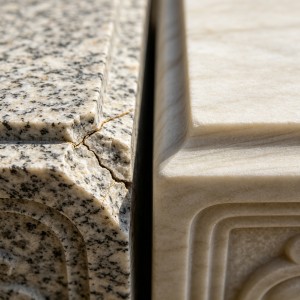
There is an open secret in the stone carving trade: the same design drawing, when executed by hand and by machine, produces two different objects.
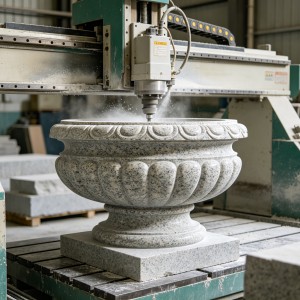
Let us start with machine carving. CNC equipment operates through scanning or programming, with cutting tools moving across the stone surface along preset paths. It is efficient, capable of running 24 hours a day, and the dimensions and patterns of pieces within the same batch are almost perfectly identical. For standard-sized granite planters, geometrically regular column bases and capitals, and modern-style ornaments with clean lines, the advantages of machine carving are clear. Delivery is fast, costs are controllable, and pieces from the same batch sit together with complete uniformity.
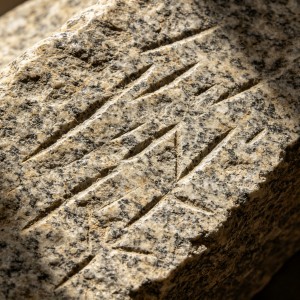
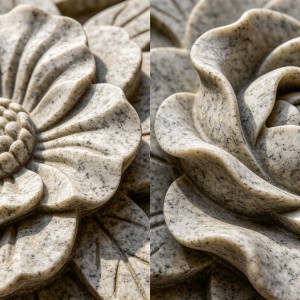
What machines cannot do falls into three areas. The first is following the stone's natural grain. The direction of veining, the distribution of color bands, and the coarseness of crystals vary even across different parts of the same block. A craftsman reads the stone before setting blade to it, studying the grain to determine the depth and angle of each cut. When carving by hand, the blade moves with the grain, the stone's structure remains intact, and the finished surface is smooth and sound. A machine follows its programmed path and will not deviate around sudden changes in grain, easily causing edge chipping or fine cracks. The second area is the transition across curved surfaces and deep recesses. The animal musculature in high relief, the curling of flower petals, the folds of draped robes — all require fluid transitions between different cutting angles, and the subtle adjustments of a human wrist are difficult for a machine to replicate. The third is antiquing and texture treatment. Experienced craftsmen use chisels of various profiles to strike the stone surface, creating tool marks that vary in density, depth, and spacing. This handcrafted texture shifts subtly under changing light — an effect that machines currently cannot easily reproduce.
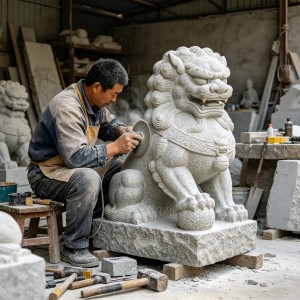
The limitations of hand carving are equally real. Output is low, lead times are long, and costs are high. A skilled artisan carving a medium-sized stone lion, from roughing out to final detailing, needs days or even weeks. The slight variations inherent in handwork are also a double-edged sword: precisely because each piece is subtly unique, the client receives something with irreplaceable individual character, yet this same variation may be seen as a flaw in projects demanding absolute uniformity.
This is therefore not a question of one replacing the other. Machines are suited to producing standard pieces faster and more consistently; handwork is responsible for delivering the irreplaceable detail and soul of high-end custom pieces. The more mature approach in the decorative stone industry today is this: machines handle the roughing out and initial carving, and hands complete the fine detailing and antiquing. This is more efficient than purely manual work, and more artistic than purely mechanical production — a way of balancing quality and cost. Understanding this division of labor is the key to understanding why two seemingly similar stone carvings can differ so greatly in price.
Written By Clara Luo.
Post time: Jul-01-2026