


We live in an era dominated by the “new.”
Smartphones get upgraded annually, fashion trends become obsolete by the season, and social media trending lists refresh every 15 minutes. “Fast” has become the default rule of survival, and “new” the sole measure of value.
Yet in another corner of the world, a group of people are moving in the opposite direction.
They are homeowners who pave their courtyard paths with solid granite slabs, designers who commission monolithic stone basins for hotel lobbies, collectors who seek out century-old stone lanterns for Japanese gardens. They are investing in things that slowly grow “older.”
Behind this seemingly anachronistic choice lies a truth overlooked by most:
The value of some things actually increases over time.
I. The Paradox of Age: Why Some Things Become More Expensive as They Grow Older
If you purchase a Qing Dynasty blue-and-white porcelain plate at an antique market, its value increases in direct proportion to its “old age”—every minute scratch bears witness to history.
If you collect a Song Dynasty painting, its price will climb with the passage of time—time endows it with cultural depth.
But in daily life, most items we purchase begin an irreversible decline in value the moment they leave the store. Cars, smartphones, sofas, fast fashion clothing... their designed lifespan is a countdown to their commercial worth.
Natural stone is one of the few materials that stands on the opposite side of time.
A genuine natural stone will not fade after three years, warp after ten, or become obsolete after thirty. It will age slowly and gracefully—developing subtle weathering on its surface, softening its edges, and allowing moss to grow in its crevices. Yet this aging is not decay, but maturation. Like the stone walls of a Gothic cathedral or the dry landscape garden at Ryoan-ji Temple in Kyoto, their beauty is precisely the result of time's carving.
II. Hand Carving: Leaving an Imprint of “Time”
If natural stone is a vessel of time, then hand carving is the ritual that breathes soul into this vessel.
Machine carving pursues “exact replication”—every line's depth, every curve's curvature is precisely controlled. The result is flawless, yet static.
Hand carving leaves behind something else entirely: traces.
An experienced stonemason's every chisel stroke—its force, angle, and rhythm—imprints subtle variations upon the stone's surface. These variations are not flaws, but evidence of human presence. Like the brushstrokes of a calligrapher or the fingerprints of a potter, they imbue a cold stone with warmth.
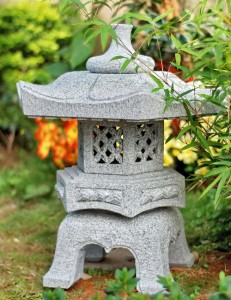
When you touch a hand-carved stone lamp, you can faintly sense those traces. Decades later, when your grandchildren touch it in the same way, those traces will still be there. It is a conversation that transcends time.
III. Business Insights: From “Transaction” to “Legacy”
For professional buyers and designers, understanding this holds tangible commercial value.
When selecting a lobby water feature for a luxury hotel project, you face two choices:
Opt for a standardized, mold-produced item—lower cost, faster delivery—but within five years, it will be drowned out by countless identical pieces in similar hotels.
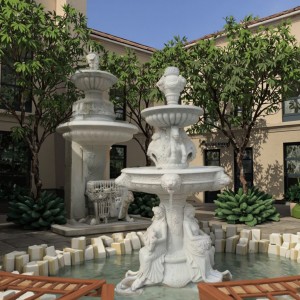
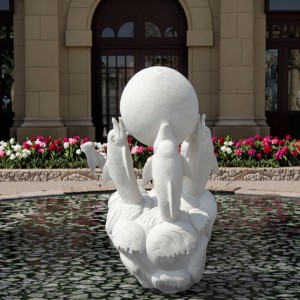
Or opt for a hand-carved monolithic stone fountain—pricier and longer to produce—yet destined to become the hotel's visual landmark within a decade, even gracing guests' social media check-in photos.
Which choice creates enduring value for your project?
When recommending a stone sculpture to private garden clients, you can tell them:
This isn't a depreciating “decorative item” destined for replacement.
It is a “heirloom” that will accompany their children's growth, witness family stories, and be passed down to future generations.
This isn't merely selling a product—it's delivering meaning. Clients willing to pay for meaning typically won't fixate on the lowest price.
IV. The Role of Magic Stone Garden: We are not creators, but “time stewards.”
At Magic Stone Garden, we often ask ourselves this question: What will everything we do today look like ten years, thirty years, fifty years from now?
The answer to this question determines how we select each block of raw stone, how we train every artisan, and how we define the standards for every finished piece.
We reject high-speed mold production because it would extinguish the innate vitality of stone.
We insist on hand carving because only hands can leave marks worthy of time's cherishing.
We offer lifetime warranties not out of blind optimism for the future, but because we know: for a truly exceptional stone sculpture, its journey has only just begun.
V. An Invitation: Make Your Project a “Future Antique”
If you're planning a project worthy of being remembered through time, we invite you to shift your perspective:
Don't ask, “How does this look now?”
Instead, ask: “What will this look like thirty years from now?”
When we measure value against the scale of time, many choices become clear.
Magic Stone Garden stands ready to partner with you, helping select elements for your project that will appreciate over time—be it a fountain, a sculpture, a stone lantern, or a set of stone benches.
One day in the future, these pieces will tell today's story to those who use this space.
Wish you a good day,
Written by Jessica Wu

Post time: Mar-09-2026