


If the guardian figures at an Eastern doorway are the stone lion and the stone tablet, then the most common gentle watcher in a Western garden is the cherub.
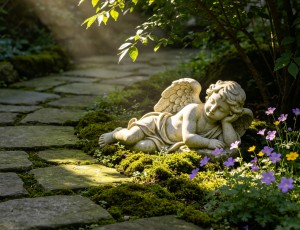
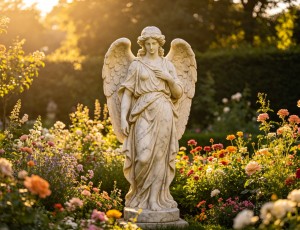
The formal name for this figure in Western stone sculpture is "cherub," derived from ancient Hebrew, first appearing in the Bible as a sacred being guarding the Garden of Eden. Over time, however, its image in stone softened from a stern divine messenger into the familiar form we know today — a plump infant with a pair of wings, its face innocent and serene. This transformation took shape during the Renaissance, when Raphael painted those cherubs gazing up at the Madonna, forever fixing the European visual imagination of what an angel should look like.
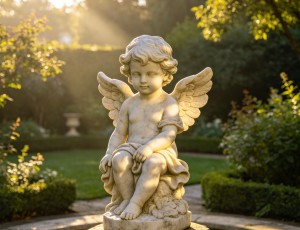
The pairing of marble and cherubs carries a particular kind of contrast. Marble is fine-grained, warm to the touch, and carries a soft translucence of its own, yet the carver uses it to express the tenderness of an infant's skin, the lightness of wings, the purity of an innocent expression. Carrara marble, with its white tone so close to human flesh, is especially suited to sculpting cherubs. When light falls upon it, it does not bounce back harshly as it might from granite; instead, it is gently caught by the stone's surface and diffused into a soft glow, as though the stone child truly possessed warmth. This very tension — expressing the most weightless of spiritualities with the heaviest of materials — is precisely what makes sacred stone sculpture so moving.
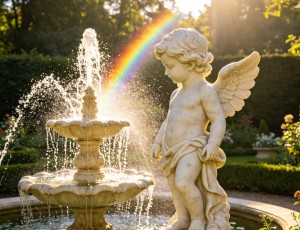
In Western gardens, marble cherubs most commonly appear in one of three poses: hands pressed together in prayer, head bowed in contemplation, or chin resting on one hand while gazing at the sky. They are usually placed beside a garden path, at the edge of a fountain or pond, or atop a gravestone in a family cemetery. They occupy no central spot, never demanding attention, yet just as you pass by, your peripheral vision catches them — a stone child quietly waiting there. If the Chinese stone lion guards the peace of the household, the Western cherub guards something softer: the tender places within the heart.

Beyond the cherub, Christian-themed marble carving encompasses far grander narratives. The Madonna and Child is an eternal motif, and the pure, warm white of marble perfectly matches the purity and solemnity of maternal love. Scenes of saints' martyrdom brim with dramatic tension — the strain of muscle, the swirling of robes, the mingling of pain and conviction on a face — all finding their most precise expression in the fine grain of the marble. Most of these works reside on cathedral façades, along monastery cloisters, or within cemeteries. In silence, the marble has outlasted a thousand years and told every story of faith that needs telling.
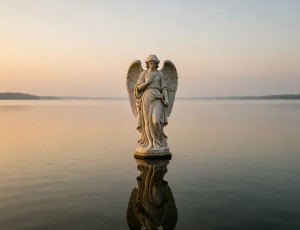
The same marble. An Eastern carver uses it to render the authority of a white marble lion; a Western carver uses it to shape the tenderness of an angel. The material is the same, the intent slightly different, yet both are ultimately about the same thing — using stone to stand guard over what is most precious.
Written By Clara Luo.
Post time: May-28-2026