


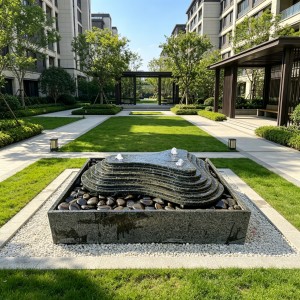
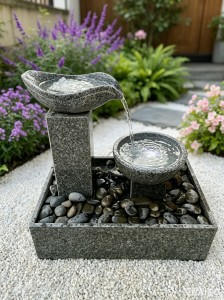
One of the most captivating sounds in a courtyard is that of water falling onto stone. Not plastic or metal, but stone — deep and mellow, like rain striking a mountain rock.
Granite is suited to fountains for several practical reasons. Its water absorption rate is below 0.5%, so water cannot seep in, and freezing winter temperatures will not crack it. With a Mohs hardness of 6 to 7, it resists weathering under sun and wind, and years of flowing water leave no trace. Its substantial weight keeps it firmly planted — vibrations from the pump cannot rattle the stone. In short, this is a material that lives with water yet fears none of it.
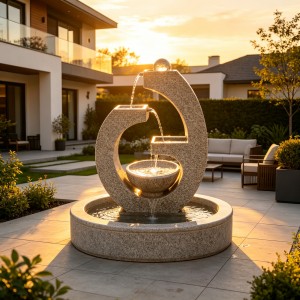
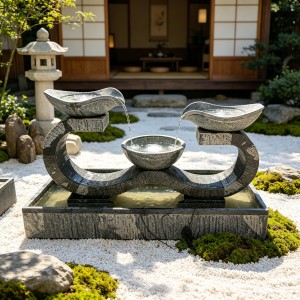
Common forms include several types. Wall-mounted fountains are installed against a wall, with water flowing from a carved stone spout into a basin below, suitable for garden walls or landscape partitions. Freestanding fountains are complete sculptural works, often featuring three or four tiers of cascading water that spill from the top layer by layer — a visual centerpiece for the courtyard. Bubbling fountains are the simplest form: a granite sphere or column with a hole drilled at the top, allowing water to well up and flow evenly down the stone surface, well suited to modern gardens. There is also the stone basin fountain, where water rises from within the basin and overflows into a reservoir below — derived from the tsukubai form of the Japanese tea garden, it carries the deepest Zen sensibility.
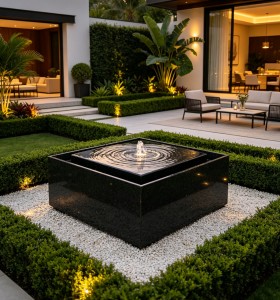
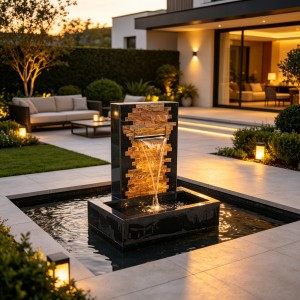
As for surface finishes, a polished surface makes the water film appear more crystalline, while a flamed or lychee finish allows the water to spread into a smooth, even sheet. Each has its own appeal.
Maintenance of a granite fountain is straightforward. In northern winters, simply drain the water to prevent freezing; the stone itself needs no covering. Routine care involves periodic cleaning of the pump and filter screen, and an occasional rinse of the stone surface to remove dust and water scale. Compared to ceramic fountains that chip easily or metal ones that rust, granite is far less demanding.
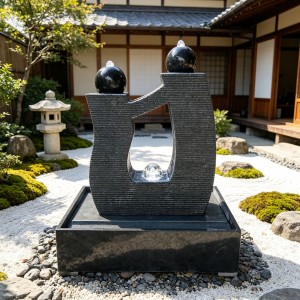
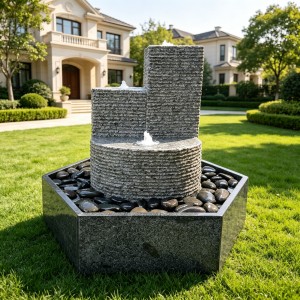
A block of granite, quarried from the mountain and carved into a fountain, lets water flow over it for a hundred years. The stone stays still; the water moves. The stone stays silent; the water speaks. Put these two elements together, and the pairing simply works.
Written By Clara Luo.
Post time: Jun-17-2026