


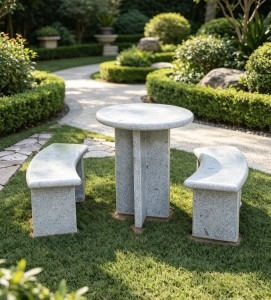
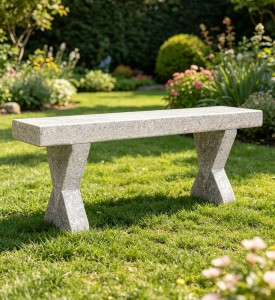
Granite is chosen for tables and benches for several clear reasons: high hardness, strong weather resistance, and substantial weight. Placed outdoors, it remains unaffected by sun, rain, snow, or frost. It needs no storage and no maintenance. Once set in place, lasting for decades is common.
Material Advantages
Granite is a plutonic rock formed by the slow cooling of magma deep within the Earth's crust. Its main components are quartz, feldspar, and mica. The higher the quartz content, the greater the hardness. With a Mohs hardness typically between 6 and 7, everyday scratches leave no mark. Feldspar determines the base color of the stone — gray-white, beige, light red, deep black — varying from quarry to quarry. Mica appears as tiny sparkling specks scattered across the surface, giving a subtle luster when viewed up close in sunlight.
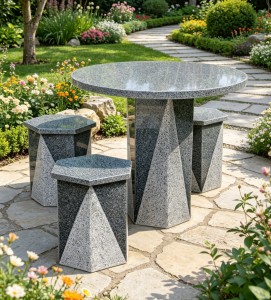
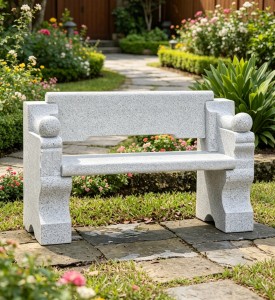
Weather resistance is another core advantage. Granite's water absorption rate is usually below 0.5%, so rainwater cannot penetrate it, and freezing in winter will not cause cracking. The surface does not oxidize or fade, remaining unchanged after years of UV exposure. Compared to wooden furniture that requires regular painting and upkeep, metal furniture that rusts, and plastic products that become brittle and faded within a few years, granite demands nearly zero maintenance. An occasional rinse to wash off surface dust is enough.
Its heavy weight is both an advantage and something to consider. A granite tabletop may be difficult for two people to lift, but the benefit is that wind will not move it, and it will not tip over. Once placed, it stays put. For windy coastal areas or high-rise terraces, stone tables and benches need no additional anchoring.
Forms and Craftsmanship
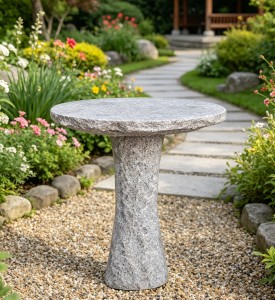
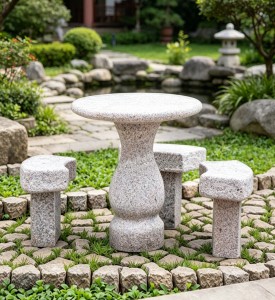
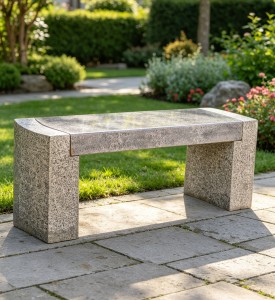
Granite tables and benches generally come in two forms. One is carved from a single block, with the tabletop or seat and the supporting structure all in one piece. The lines are clean, there are no joints, and it is the most durable option. The other is an assembled style, with the tabletop made from a large slab and the legs from stone columns or blocks, suitable for larger, longer tables.
Several surface finishes are available. A polished finish is smooth to the touch with even reflection, well suited to modern-style gardens. A flamed finish is created by exposing the stone to high-temperature flames, producing a uniformly rough texture that is non-slip and matte. This is the most common finish for outdoor stone tables. A lychee finish is achieved by hammering the surface with a specialized tool, creating densely packed small pits with a stronger texture and even better slip resistance. Each finish suits different styles and environments.
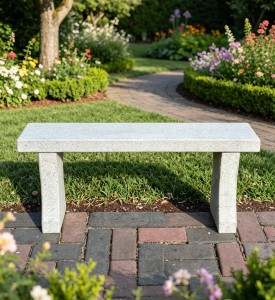
Granite tables and benches fit a wide range of settings. A set placed on the lawn with a few chairs forms an outdoor dining area. A small round table with stone stools in a balcony corner is perfect for tea and reading. In commercial spaces such as café terraces and hotel gardens, granite furniture is also a common choice due to its durability and low maintenance.
Written By Clara Luo.
Post time: Jun-03-2026