


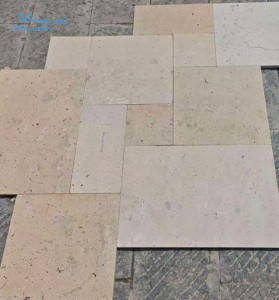
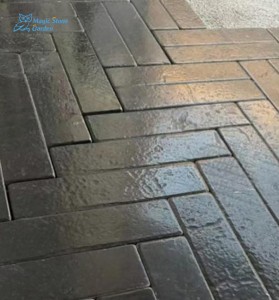
While granite dominates the outdoor decorative stone market, a material called limestone is attracting renewed attention from European and North American clients. It does not belong to the traditional "hard stone" category, but its distinctive texture and warm tones give it a presence in certain garden styles that granite simply cannot replace.
What Limestone Is
Limestone is a type of sedimentary carbonate rock, formed over hundreds of millions of years from marine biological debris and calcium carbonate deposits cemented together under geological pressure. Its main component is calcite, with a Mohs hardness of 3 to 4 — far lower than granite — yet it remains widely used in outdoor architecture and landscaping. The name "limestone" itself points to its geological family: it shares the same origin as lime, which has been used in building for thousands of years.
The most striking characteristic of limestone is its warm colour palette. Common shades range from off-white and pale yellow to honey tones and light brown. The colours are soft and gentle, entirely unlike the cool hardness of granite. The surface often shows traces of shell fossils and fine natural pitting — these "imperfections" are precisely what give limestone its most appealing textural character.
How It Differs from Granite
The two materials have fundamentally different personalities. Granite is dense, hard, and restrained in colour — suited to scenarios demanding durability and a sense of strength. Limestone is softer, warmer, and gentler in tone — suited to spaces calling for approachability and a natural feel. Granite finishes lean toward polished or flamed surfaces that emphasise lustre and textural contrast; limestone is more often given a naturally cleft, acid-washed, or lightly honed surface that preserves its organic undulations and pitting.

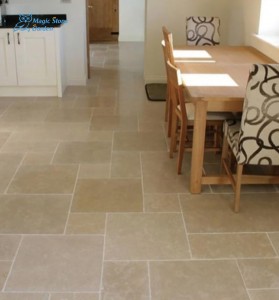
In terms of physical performance, limestone is not as wear-resistant or frost-resistant as granite. Its water absorption rate is higher, so in cold climates, outdoor use requires either low-absorption varieties or surface protection treatment. But limestone's advantages are equally clear: the relatively soft stone is easier to cut and shape, allowing for complex mouldings and carved details. Its warm colouring is highly compatible with classical European architecture and Mediterranean-style gardens.
Common Uses in the Garden
The most classic outdoor use of limestone is paving — garden paths, terrace floors, and courtyard plazas. Large areas of limestone paving create a warm, timeworn character. Many old European city squares are still paved with limestone, their colours ranging from pale yellow to light brown, with centuries of foot traffic producing a patina that gives the entire space a sense of age. Wall cladding is another common application: natural-faced limestone, either dry-hung or laid as masonry, appears frequently in French and Mediterranean-style villas, where its soft tones harmonise beautifully with greenery and blue skies.

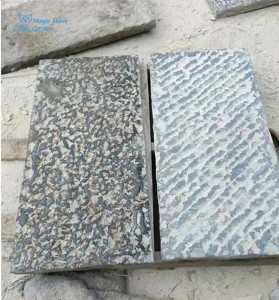
Limestone planters and carvings form a small but refined category. Because the material is relatively soft, it is well suited to gently curved forms — planters, troughs, and small sculptures all perform well. These products generally appeal to clients who favour natural textures over the strength of granite, and who value the material's warmth and the visible traces of handwork.
Points Worth Noting
Limestone has good colour stability, but its surface tends to collect dust, and in rainier regions it may develop moss. In certain garden styles this mossy patina is considered an asset, but expectations should be aligned with the client. Limestone does not tolerate prolonged exposure to acidic environments — acid rain and chlorinated pool water will both erode the surface. For outdoor use in cold regions, low-absorption varieties are recommended, along with proper base drainage.
Limestone is not meant to replace granite, nor is it suitable for every garden. But in projects that pursue a warm base tone, handcrafted texture, and a sense of age, it carries a quality that granite cannot offer. That quality may be exactly what some of your clients have been looking for.
Written By Clara Luo
Post time: Aug-27-2026