



The same small frog has squatted on different soils for thousands of years, carrying entirely different meanings. Some use it to pray for rain, some to call back lost fortune, some to bridge heaven and earth. When a piece of stone is carved into a frog, what is carved into it is the wish of an entire civilization.
Southern China & Southeast Asia: A Frog's Croak Foretells a Harvest
Among the mountain peoples of Guangxi, Yunnan, Laos, and Thailand, the frog is a messenger between heaven and earth.
"Bronze in the north, drums in the south." In the bronze drum culture of southern China and Southeast Asia, the most prominent position on the drumhead is often occupied by a ring of frogs. The Tang-dynasty writer Liu Xun recorded in his Records of the South of the Five Ridges a bronze drum unearthed in his time: "Its surface is faintly raised, mostly cast with the shapes of frogs and turtles." The locals, he noted, considered these frogs the very soul of the drum. The Zhuang people believe the frog is the daughter of the Thunder God, responsible for carrying messages between the human world and the heavens. So when the frogs croaked before a rain, the ancient people understood: it was time to sow the seeds. Bronze drums also often feature a "stacked frog" motif—a large frog carrying a smaller one on its back, symbolising the safety of mother and child, and the flourishing of the family line.
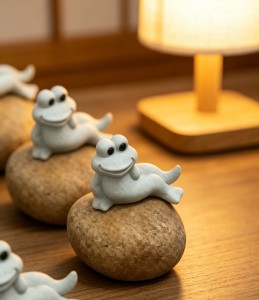

This belief travelled southward with the bronze drums and entered the Thai royal court. During the Royal Ploughing Ceremony, when the bronze drum sounds, the frog deity is believed to arrive.
Japan: The Frog Temple's Philosophy of "Return"
In Ogori City, Fukuoka Prefecture, Japan, stands the Nyoirin-ji Temple, better known as the "Frog Temple." More than five thousand frog sculptures—stone frogs, bronze frogs, porcelain frogs—crowd its gardens, pathways, and even the main hall.
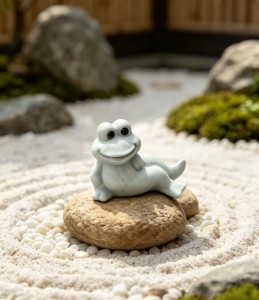
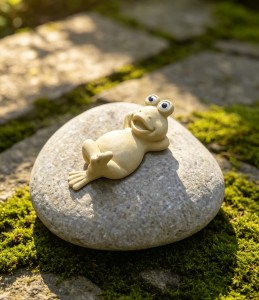
Everything stems from a Japanese homophone. The word for frog in Japanese is kaeru, which sounds exactly like the word for "return." And so this little creature became the lucky charm for "safe return," "fortune returns," and "wealth returns." The temple's most famous piece is a giant golden frog with its mouth wide open, known as the "Pass-through Frog." People bow and step through the frog's mouth while silently making a wish, following the belief that "happiness returns through the frog's mouth."
A single frog, calling back every piece of lost good fortune, one by one.
South America, Andes: The Smiling Toad that Prays for Rain
The Caral Civilization of Peru (circa 2600 BCE) carved a "Smiling Toad" into a mud-brick relief. The toad wears a gentle smile, yet between its hands is a human face twisted in distress. Archaeologists explain that in Andean civilisation, the toad is a symbol of water, and the human face represents the people waiting for rainfall to relieve a drought.
The Inca later crafted painted pottery frogs called zuma, believing they could control the weather and bring a bountiful harvest. In an age when survival depended on the sky, a single stone frog held the hope of an entire year.
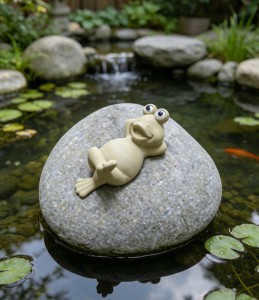
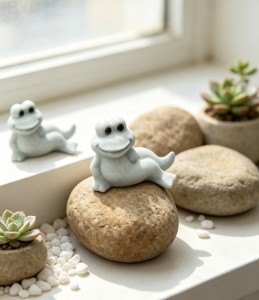
When such unspoken cultural agreements from across the world settle into a single stone carving, that piece gains a quiet weight. A frog stone sculpture resting on a desk makes no sound and takes no leap, but it quietly gathers good omens from all over the world for its keeper.
Written By Clara Luo.
Post time: May-15-2026