


Carved from the same granite, a stone lamp placed in a Kyoto tea garden feels utterly different from one set in a Suzhou garden. One seeks concealment, the other commands presence.
Form: Complexity vs. Simplicity
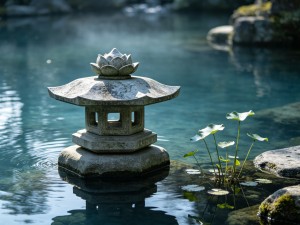
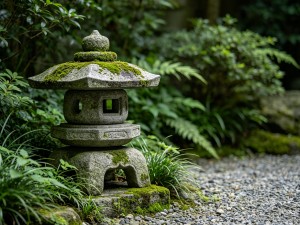
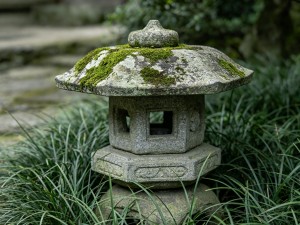
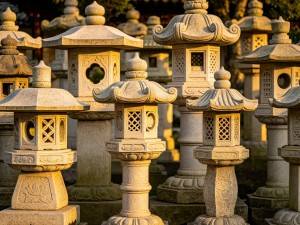
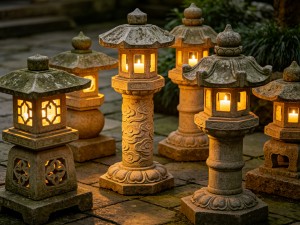
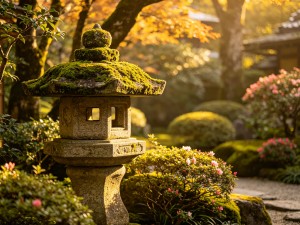
A Japanese stone lantern (tōrō) is structurally elaborate. The standard type stacks six parts: the jewel-like finial, the roof, the firebox, the middle platform, the shaft, and the base. Heights typically range from 60 to 200 cm — compact and low. The Kasuga lantern features a tall, slender shaft; the Yukimi lantern does away with the shaft entirely, squatting low to the ground, designed specifically for viewing snow.
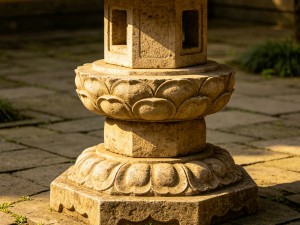
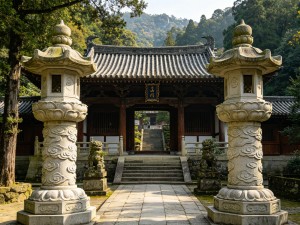
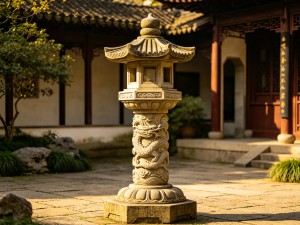
Chinese stone lights are structurally straightforward: base, pillar, lamp tray, and shade. They can reach several meters in height, with a robust pillar often carved with couplets or lotus motifs. Placed in pairs before temple gates, they convey a stately dignity even from a distance.
Origins: Same Source, Different Paths
Stone lamps began as Buddhist offerings. The oldest surviving Chinese example is the Lamp-Lighting Stone Pagoda at Tongzi Temple from the Northern Qi Dynasty — over 5 meters tall and 1,400 years old. When the form entered Japan, the tea ceremony absorbed and reshaped it. What had been a ritual implement became a garden accent, setting it on a path of rustic simplicity.
Placement: Hiding vs. Pairing
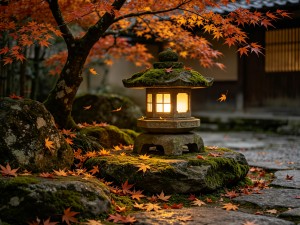
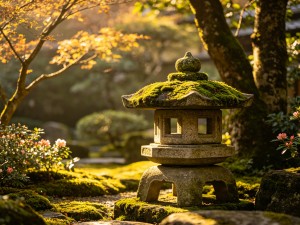
Japanese lanterns excel at hiding. They withdraw to the edges of grass, crouch beside stream stones, or disappear behind maple trees. The pleasure of glimpsing a moss-covered lantern when least expected — that is the cherished beauty of the chance encounter.
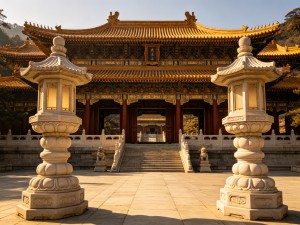
Chinese stone lights excel at pairing. In front of main halls, flanking temple gates, or lining the central axis of a pathway, they stand in symmetrical pairs — dignified, direct, and unmistakable. They are not meant to be stumbled upon; they are meant to be faced. That symmetry itself is the ritual.
Spirit: Wabi-sabi vs. Grandeur
The aesthetic core of the Japanese lantern is mono no aware and wabi-sabi — an acceptance of impermanence and imperfect beauty. The stone surface is deliberately left rough, even encouraged to grow moss, so that time leaves a visible trace. A fine Japanese stone lantern looks as though it has been sitting in that garden for three hundred years.
Chinese stone lights pursue fullness and grandeur. The carving is meticulous — lotus flowers, auspicious clouds, dragons, phoenixes, deer, cranes — every cut distinct and assured. They do not hide from time; they stand against it with their sheer mass.
One stone lamp. For the Japanese, it illuminates a subtle and profound mystery; for the Chinese, it illuminates an enduring sense of order. The same granite, different cultural orientations — each has stood in its own lamplight for over a thousand years.
Written By Clara Luo.
Post time: May-21-2026