


Natural stone has veins. That is not cracking. But for buyers unfamiliar with the characteristics of granite, the two can sometimes be confused. Knowing what natural markings look like helps you assess your products accurately upon receipt.
Natural Veins: The Fingerprint of Stone
Granite was formed by magma cooling slowly deep within the Earth's crust. Across hundreds of millions of years of geological movement, mineral melts crystallised, flowed, and solidified at different rates. Later hydrothermal activity injected new mineral components along faint fissures, ultimately creating the markings visible today. Every line, in a sense, is a record of geological time.
The most common natural veins are quartz veins — white or milky bands running diagonally across the stone surface. These are not cracks. Quartz itself is extremely hard, and the vein is fully fused with the surrounding stone. After polishing, the surface is flat and smooth, with no unevenness felt by hand. Another type is colour lines, formed when mineral elements such as iron and manganese seep and settle along the stone's bedding planes, leaving dark or reddish-brown streaks. These lines, too, are integrated into the stone body and do not compromise its strength.
What these markings share in common: the lines run in a natural direction, vary irregularly in width, and feel smooth to the touch. They are natural features of granite, not defects. Much like wood grain in timber or pores in leather, the recognisability of a natural material lies precisely in these so-called imperfections.
Hairline Cracks: Already Screened Out
Hairline cracks are minute fissures that can exist inside the stone. They typically form in one of two ways. The first is stress release during quarrying, such as when expansive agents or wire saws trigger capillary fractures — this occurs occasionally in dark, fine-grained granites like Shanxi Black and China Black. The second is micro-fissures already present in the raw block in its natural state.
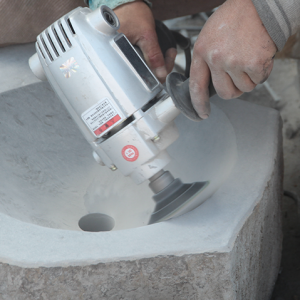
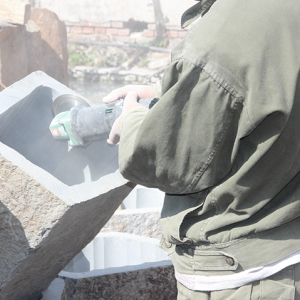
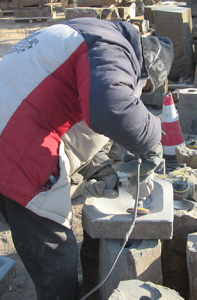
Reputable factories screen raw blocks and roughed-out pieces at the selection and shaping stages. The inspection after roughing is a critical checkpoint. If a hairline crack is found, the factory assesses whether it can be sealed with resin injection and used, or whether the piece should be discarded. Resin injection is a standard industry practice; the treated stone is structurally sound, and its serviceability and lifespan are unaffected. After finishing and before packing, quality control checks again. Under normal operating procedures, stone with structural risks does not enter the packing stage.
A Quick Guide for Buyers
If you have doubts about markings on a piece you have received, here is how to tell the difference:
Natural veins feel smooth to the touch, remain clearly visible after wiping with a damp cloth, and appear continuous under different lighting conditions. These lines are natural features of the stone and are no cause for concern.
If you suspect a crack, wipe the surface with a damp cloth. Stone dust, when wet, briefly fills the tiny gap, making the crack appear to disappear. Once the water evaporates, the mark reappears. Areas treated with proper resin injection for hairline cracks are virtually invisible to the naked eye at a normal viewing distance and do not affect the product's appearance or performance.
The Appeal of Natural Stone
There is a saying in the Western marble trade: "A marble without veins might as well be artificial stone." The beauty of natural stone lies in the memory of the earth carried in each piece. A good product honestly shows the evidence of its origin. Understanding these natural characteristics is a way of respecting the material itself, and it forms the common ground on which buyer and seller build shared quality standards.
Written By Clara Luo.
Post time: Jul-23-2026