


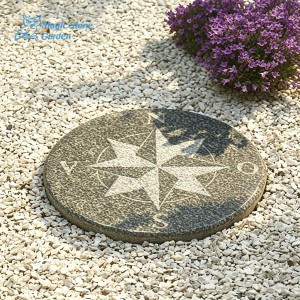
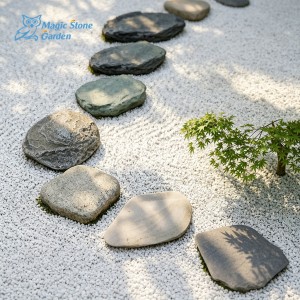
Stepping stones are one of the most flexible elements in garden paving. Rather than covering an entire area, they connect points into a line, creating a walkable path across lawns, gravel, or shallow water.
Diversity of Shapes
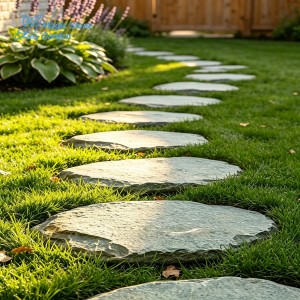
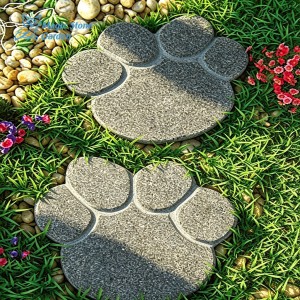
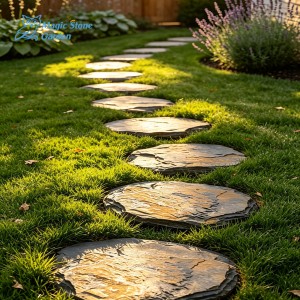
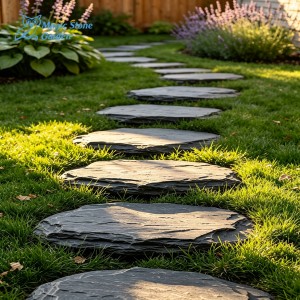
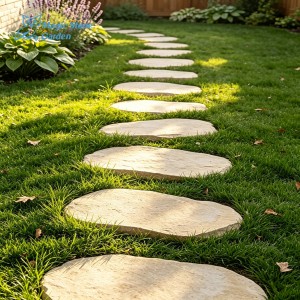
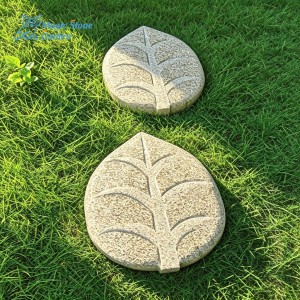
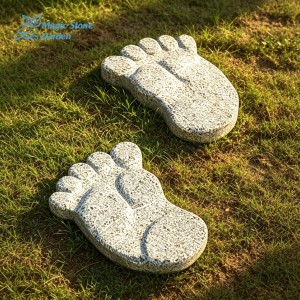
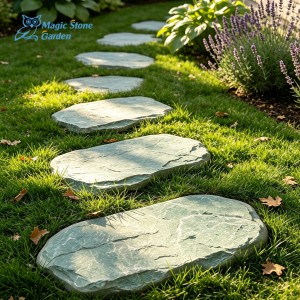
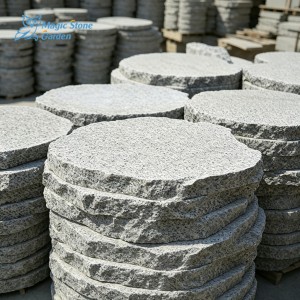
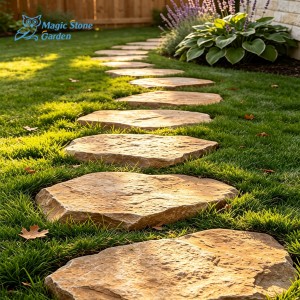
The stepping stones commonly available today have long moved beyond squares and rectangles. Circular stepping stones, when arranged in a row, resemble lotus leaves floating on water, a natural fit for Japanese and other oriental-style gardens. Irregular natural-face stepping stones preserve the original contours of quarried stone, with uncut edges and varied outlines; placed among grass, they look like natural rock emerging from the earth. Polygonal stepping stones — hexagons, octagons — can be pieced together into tighter, more cohesive patterns, well suited to modern gardens. There are also animal-shaped stepping stones designed for children — elephants, turtles, fish — that turn walking into a playful experience. Some manufacturers accept custom-shaped stepping stones, cutting to a client's own pattern or outline, a service particularly common in high-end landscape projects.
A Range of Application Scenarios
A lawn path is the most basic application. Stone spacing is set at roughly one stride, the surface flush with the grass or slightly recessed so lawnmowers can pass over without obstruction. In gravel gardens, stepping stones are set a little above the gravel surface to prevent loose stones from rolling onto the walking surface and creating a slip hazard. Stepping stones across shallow water are perhaps the most Zen-like application: the stone surface sits a few centimetres above the water, allowing a person to walk over flowing water — a classic technique in oriental gardens.
On a sloped garden, stepping stones can serve as simple grass steps, replacing the rigid feel of continuous staircases. Laid step by step along a gentle slope, they merge naturally with the land. In vegetable gardens and flower borders, large irregular slabs set into the planting areas provide a place to stand while weeding or harvesting, both practical and useful for dividing planting sections. In commercial settings — a hotel lawn wedding aisle, a resort poolside path, a café's outdoor garden trail — stepping stones are ideal for creating temporary or semi-permanent walkways. In these scenarios, clients tend to favour stone with strong surface texture and a high degree of visual integration with the natural surroundings.
Choice of Material
Granite, with its high hardness and wear resistance, is suitable for high-traffic areas. Slate, thanks to its naturally cleft, slip-resistant surface and dark grey tones, blends effortlessly with vegetation. Quartzite offers a wide colour range, ideal for spots where the stone itself is meant to be a visual highlight. Stepping stones of different shapes and materials can be mixed together; as long as some unity is maintained in colour or texture — for instance, a shared colour palette across different shapes, or the same shape with different surface finishes — the overall effect will not look cluttered.
What stepping stones do is simple: they give human footsteps a place to land within nature, and leave the rest to the grass, gravel, and moss.
Written By Clara Luo.
Post time: Jul-08-2026